

Google Business Profile Optimisation for Multi-Location Businesses in India
For a business with a physical address in India, the Google Business Profile is usually worth more than the website in the first six months. It appears above the organic results, it carries the phone button, and it is the only listing most people on a phone will ever tap. Run several locations and it stops being one profile to maintain and becomes a system to manage.
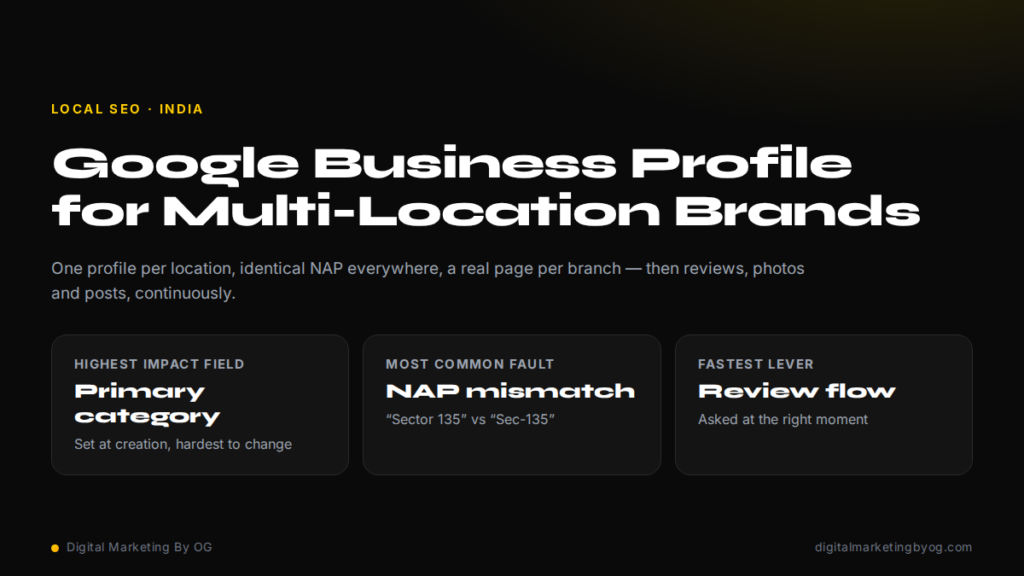
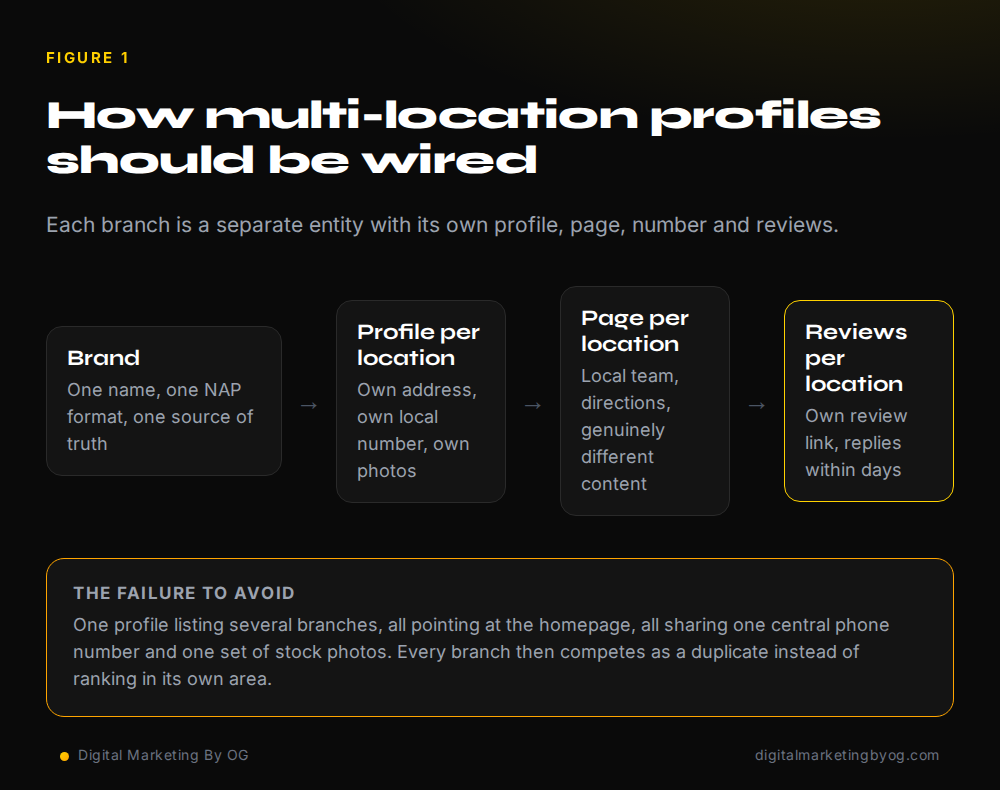
Short answer: create one profile per physical location, never one profile with several addresses. Keep the business name, address and phone number byte-identical across the website, every profile and every directory. Give each location its own page on your website and link the profile to that page rather than the homepage. Then work categories, photos, reviews and posts continuously rather than once.
Get the foundations right before anything else
Three settings decide most of your local ranking and they are all set during creation, which is why they are also the hardest to change later.
Primary category
This is the single most influential field in the profile. Google matches queries to the primary category far more strongly than to anything in your description. Choose the one that describes what you are, not what you also offer — a company that builds websites and runs ads is a "Marketing agency" or a "Software company", not both. Add the rest as secondary categories, which help but carry much less weight.
Business name
Use the real, registered trading name and nothing else. Stuffing a city or a keyword into the name — "Sharma Dental Clinic Best Dentist Noida" — still happens constantly in India and still gets profiles suspended. It also creates a name mismatch with every other listing you own, which weakens the consistency signal you are trying to build.
Address and service area
If customers visit you, use the address and show it. If you travel to customers, set a service area and hide the address. Do not do both, and do not invent a coworking address for a city you do not operate in — Google verifies more aggressively than it used to, and a suspended profile takes weeks to recover.
The multi-location rules that actually matter
Managing five locations is not five times the work of managing one, provided you set the structure up correctly. The failures I see are almost always structural rather than effort-related.
| Rule | Why it matters | Common mistake |
|---|---|---|
| One profile per physical location | Each location ranks in its own area | One profile listing several branches in the description |
| A dedicated website page per location | Gives the profile something local to point at | Every profile links to the homepage |
| Unique local phone number per location | Strengthens the local signal and makes tracking possible | The same central number on all profiles |
| Identical NAP formatting everywhere | Consistency is the trust signal | "Sector 135" on one, "Sec-135" on another |
| Separate review flow per location | Reviews are counted per profile, not per brand | All reviews landing on the head office profile |
| Location-specific photos | Google detects reused stock imagery | The same five photos on every profile |
The location page on your website should carry the address in text, embedded directions, the local phone number, the staff or team at that branch, and content that is genuinely different from the other location pages. Copying one page five times and swapping the city name is the fastest way to get all five treated as duplicates.
Reviews: the part everyone under-invests in
Review count, review velocity and review recency all feed local ranking, and the text of reviews feeds relevance — a profile whose reviews repeatedly mention "root canal" will surface for that query more readily than one with the same rating and generic praise.
- Ask at the moment of satisfaction, not in a monthly email blast. A short link sent on WhatsApp within an hour of service converts far better than anything else in India.
- Use each location’s own review link so reviews land on the right profile.
- Reply to every review, including the good ones, within a couple of days. Replies are visible to customers and show the profile is maintained.
- Never buy reviews. Sudden bursts from accounts with no history are the pattern Google filters for, and the profile carries the damage, not the seller.
- Answer a bad review factually and briefly, then take it to phone or email. The reply is written for the next reader, not for the complainant.
Photos, posts and the fields most profiles leave empty
Completeness is itself a ranking factor, and most Indian profiles are half filled. Work through every field: services with descriptions and prices, products, opening hours including holiday hours, attributes, the business description, and the appointment or booking link.
- Photos. Real photos of the premises, the team and the work, geotagged where possible, added every month rather than in one batch at setup.
- Posts. One a week is enough. Offers, new services, answers to questions customers keep asking. Posts expire, which is precisely why regular posting reads as an active business.
- Q&A. Seed the questions you are actually asked and answer them from the business account. This section is public, unmoderated and routinely hijacked by competitors on profiles nobody watches.
- Services. List them individually with real descriptions rather than one line. This is text Google can match against queries.
Citations and consistency across the web
Foundational citations still matter in India: Justdial, IndiaMART, Sulekha, industry directories, and your own LinkedIn company page. The value is not the link, it is the corroboration — multiple independent sources confirming the same name, address and phone. Build a single source-of-truth document with the exact formatting and use it everywhere, including the punctuation.
Audit old listings before creating new ones. A branch that moved three years ago and still has a live listing at the old address is actively contradicting your current profile.
Measuring whether any of it worked
Profile insights give you calls, direction requests, website clicks and the searches that surfaced you, split by location. Tag the website link on each profile with a UTM so profile traffic is separable in Analytics. Then track the only local metric that really matters: enquiries per location per month, compared with the same month last year.
The mistakes that cost the most
- Keyword-stuffed business names, which risk suspension and break consistency
- All profiles pointing at the homepage instead of location pages
- Duplicate profiles created by different staff over the years and never merged
- Hours that are wrong on festivals, which generates one-star reviews from people who found the shop closed
- Treating the profile as a setup task rather than a channel that needs weekly attention
Frequently asked questions
How many Google Business Profiles can one business have?
One per physical location that has distinct staff and is open to customers during stated hours. Multiple profiles at the same address for the same business are duplicates and will be merged or suspended. Separate legal entities at one address can each have a profile if they genuinely operate separately.
Does a Google Business Profile help if I have no shop?
Yes, as a service-area business. You hide the address and define the areas you serve. You still get the map pack, the call button and reviews; you just will not rank for "near me" searches inside a shop-heavy result.
How long does local SEO take to work in India?
Profile completeness and category fixes can move visibility in two to four weeks. Review-driven and citation-driven improvement is slower, typically three to six months, because it depends on accumulating genuine signals rather than editing fields.
Should each location have its own website page?
Yes, and it should be genuinely different from the others: local address, local number, local team, local photos, and content about that area. Duplicated city pages are worse than no city pages at all.
What is the fastest way to improve local rankings?
Fix the primary category, complete every empty field, and start a consistent review flow. Those three, done properly, outperform almost any amount of on-site work for a local business in its first quarter.
About the author
Related guides
- Branding and local SEO services — profile setup, citations and map pack work.
- Technical SEO audit checklist — the on-site half of the same job.
- Why every small business needs a website — what the profile should be pointing at.
Running more than one location and not sure the profiles are set up correctly? Send the list through the contact page and you will get an audit of each one.