

How to Get Into Google AI Overviews: An AEO Guide for Indian Businesses (2026)
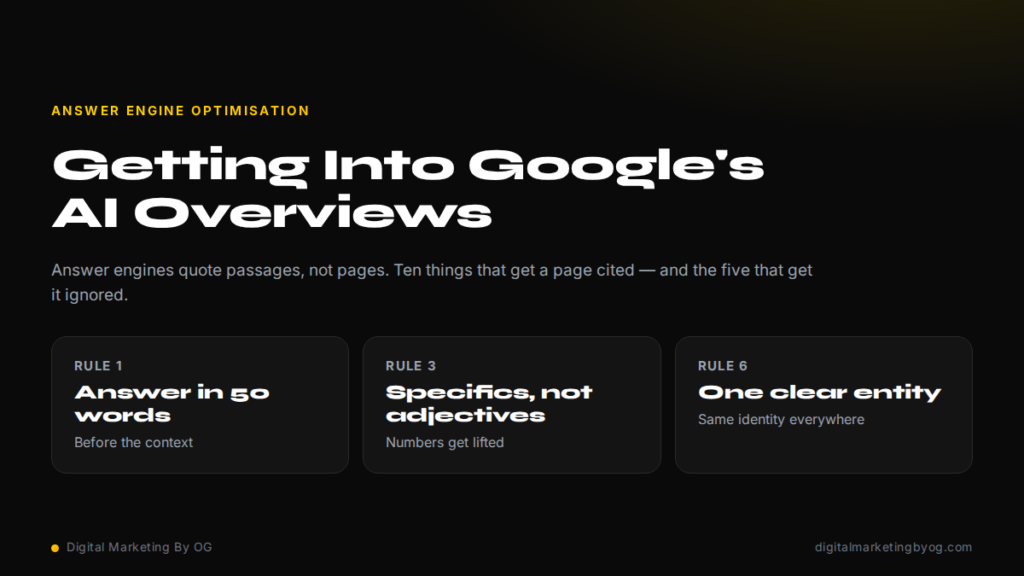
A growing share of searches in India never reach a website. Google answers at the top of the page, cites three or four sources, and the user leaves satisfied. That is not a reason to abandon SEO — it is a reason to change what you optimise for. Being the page that gets quoted is now worth more than being the page ranked fourth.
Short answer: you cannot buy or submit your way into an AI Overview. You get cited by being crawlable, by answering a specific question cleanly in the first few lines of a page, by backing claims with concrete detail, by marking up who you are and who wrote it, and by being corroborated elsewhere on the web. Answer engines quote sources they can parse confidently and verify independently.
How answer engines choose what to quote
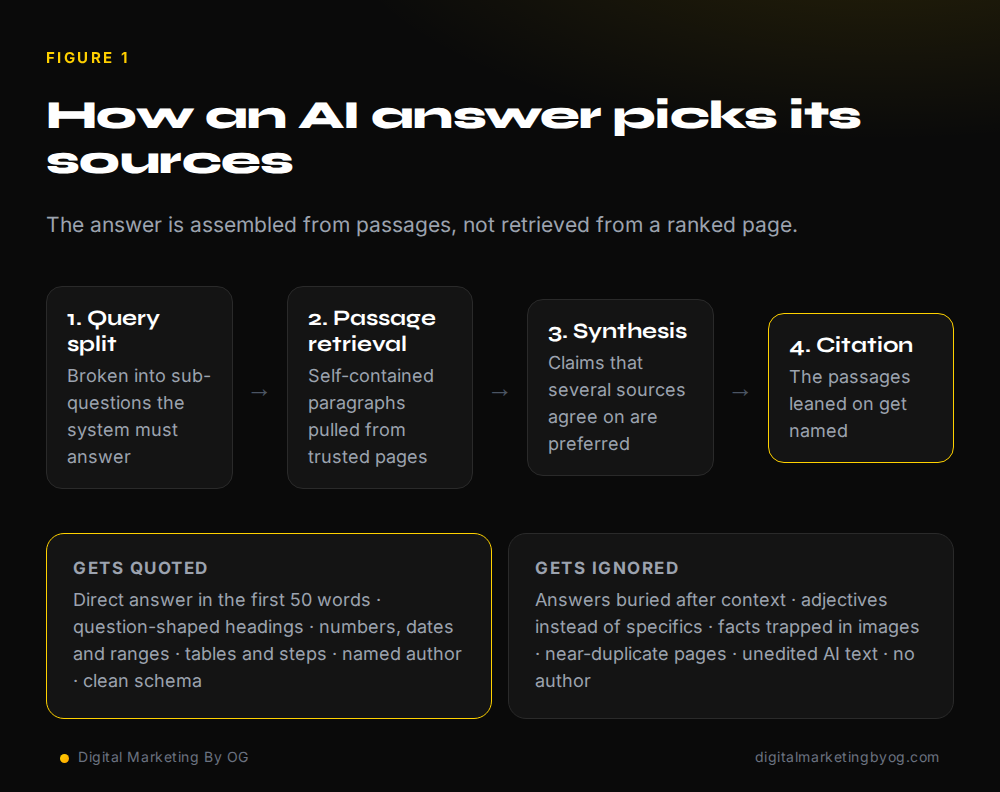
An AI Overview is assembled, not retrieved. The system breaks the query into sub-questions, gathers passages from pages it already trusts for that topic, and synthesises an answer, citing the passages it leaned on. Three consequences follow, and each is actionable.
- Passages get cited, not pages. A single clear paragraph can be quoted from an otherwise ordinary article, which is why structure matters more than total word count.
- Ambiguity is fatal. If a passage requires the surrounding page to make sense, it will not be lifted. Self-contained answers win.
- Corroboration decides trust. A claim that appears consistently across several independent sources is safer to repeat than one that appears on your site alone.
Ten things that get a page cited
1. Answer in the first fifty words
Put a direct, complete answer immediately under the heading that asks the question — before the context, before the history, before the story about why the topic matters. If a reader would have to scroll to find the answer, a language model has to guess, and it will prefer a competitor who did not make it guess.
2. Use real questions as headings
Headings phrased the way people actually search — "how long does SEO take in India" rather than "Timelines" — give the retrieval step an obvious anchor. One question per heading, answered directly beneath it.
3. Give specifics, not adjectives
Numbers, ranges, dates, named tools, named platforms and stated limitations are quotable. "Affordable" and "world-class" are not. A sentence like "a business website in India typically costs ₹10,000 to ₹35,000 to build in 2026" can be lifted whole; "we offer cost-effective website solutions" cannot.
4. Structure content so it can be extracted
Comparison tables, ordered steps and short bulleted criteria are the formats that appear most often inside generated answers. If your key information exists only inside a long paragraph or, worse, only inside an image, it is effectively invisible to the systems doing the quoting.
5. Mark up the page properly
Article with a named author, Organization or LocalBusiness for the business, BreadcrumbList for context, FAQPage where visible questions exist, and Product or Service on commercial pages. Structured data does not force a citation, but it removes the ambiguity that stops one. Every block must parse cleanly — a broken JSON-LD block is worse than none.
6. Make the entity behind the content unambiguous
This is the step most businesses skip. Answer engines reason about entities — people, companies, products — not just pages. A person or brand should have one authoritative page, one consistent name, a Person or Organization schema block reused across the site with the same identifier, and sameAs links to independent profiles that confirm the same identity. Without that, three pages about the same person read as three loosely related documents.
7. Show who wrote it and why they would know
A named author with a real biography, verifiable experience and a linked profile is a stronger signal than any keyword placement. Content published under a company email address or "admin" carries no experience signal at all.
8. Stay crawlable to the systems doing the reading
Check robots.txt for rules blocking AI crawlers. Google’s AI training crawler and several third-party assistants can be excluded separately from Googlebot, and plenty of sites block them by accident through a copied robots file. Decide deliberately: blocking protects your content from training but also removes you from the answers.
9. Be findable in more than one place
Corroboration is the quiet ranking factor of the answer era. A LinkedIn profile, a company page, directory listings, guest articles, a Google Business Profile and mentions on other sites all confirm the same facts about you. Answer engines weight claims they can verify in more than one place, which is exactly why a single well-written page about yourself rarely wins on its own.
10. Keep it current and say so
Include the year where it is genuinely relevant, update figures when they change, and let the modified date reflect real edits. Answers about prices, tools and platform behaviour decay quickly, and stale pages get quietly dropped from the citation set.
What this looks like on the page
| Element | Written for rankings | Written for answers |
|---|---|---|
| Opening | Context and background | Direct answer in two sentences |
| Headings | Topic labels | The question a person types |
| Claims | "Fast and affordable" | "₹10,000–₹35,000, live in two weeks" |
| Format | Long prose | Prose plus tables, steps and criteria |
| Author | Admin or company name | Named person with a linked profile |
| Schema | Whatever the plugin adds | Article, Person, Organization, FAQ, consistent identifiers |
How to tell whether it is working
There is no "AI Overview" report. Use proxies. In Search Console, watch for queries where impressions hold or rise while clicks fall — that pattern usually means you are being shown inside an answer rather than clicked. Track branded search volume, which rises when you are cited without being visited. And simply ask the assistants: run your key questions through Google’s overview and the main chat assistants once a month and record whether you are named.
Expect the traffic mix to change shape. Fewer visits from informational queries, roughly the same or better from commercial ones, and more people arriving already knowing who you are.
What not to do
- Publishing dozens of near-identical pages about the same subject. Duplication splits the entity instead of strengthening it, and answer engines pick one source per claim.
- Adding FAQ schema for questions that do not appear on the page.
- Stuffing a name or keyword into every heading. Repetition is not corroboration.
- Publishing unedited AI text. It is fluent, generic and unquotable, because it contains no specifics worth lifting.
- Hiding key facts in images or PDFs.
Frequently asked questions
How do I get my website into Google AI Overviews?
Be crawlable, answer one specific question directly at the top of a page, support the answer with concrete numbers and structure, mark up the page with Article, Organization and author schema, and make sure the same facts about you appear on independent profiles. There is no submission process and no paid placement.
Is answer engine optimisation different from SEO?
It is an extension of it. Everything technical still applies — crawling, indexing, speed, internal links. What changes is the writing: self-contained answers, extractable formats, verifiable specifics and clear entity identity, rather than keyword density.
Do AI Overviews reduce website traffic?
For simple informational queries, yes. For commercial and comparison queries the effect is smaller, and being cited inside the answer carries brand value that a fourth-place blue link never did. The sensible response is to move informational content up the funnel and make commercial pages unmistakably better.
How long does it take to appear in AI answers?
Once a page is indexed, citation can happen within weeks. Entity-level recognition — being named as a person or brand rather than a page — takes longer, typically a few months of consistent signals across your site and independent profiles.
Should I block AI crawlers?
If your business depends on being discovered, no — blocking removes you from answers as well as from training. Publishers selling access to their archive reasonably decide otherwise. Make it a deliberate decision rather than one you inherit from a copied robots.txt.
About the author
Related guides
- Technical SEO audit checklist — the crawlability and schema groundwork this depends on.
- How to choose an SEO expert in India — including what to ask about AI search.
- SEO services — technical, content and entity work in one retainer.
Want to know which questions in your category currently return an AI answer, and who is being cited? Send your topic list through the contact page and you will get the check back.