Google Ads vs Meta Ads in India (2026): Which Delivers Cheaper Leads?
The question is asked as though one platform is better. It is not the right question. Google Ads and Meta Ads do different jobs, fail for different reasons, and suit businesses at different stages. Running the wrong one first is how most Indian businesses conclude that "paid ads do not work for us".
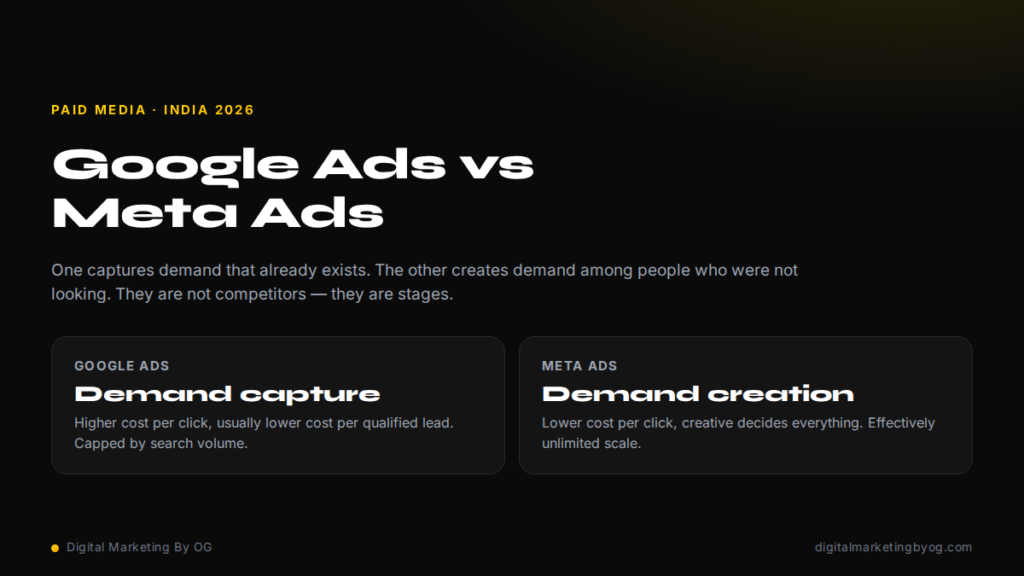
Short answer: Google Ads captures demand that already exists — someone is searching for what you sell, right now. Meta Ads creates demand among people who were not looking. If customers actively search for your category, start with Google. If they do not know your product exists, or the purchase is visual and impulsive, start with Meta. Businesses with budget for both usually find Google cheaper per lead and Meta cheaper per thousand people reached.
The real difference: intent
Everything else follows from this. A person typing "emergency dentist in Noida" has a problem now and will convert at a rate no social campaign can match. A person scrolling Instagram at eleven at night has no such problem, which is why the same advert that produces a ₹300 lead on search produces a ₹60 click and no lead on Meta.
The corollary matters just as much: search demand is capped. If four hundred people a month search for your service in your city, no budget will buy you a five-hundredth. Meta has no such ceiling, which is why growing brands eventually need it even when search is cheaper per conversion.
Side by side
| Google Ads | Meta Ads | |
|---|---|---|
| Buyer state | Actively searching | Passively scrolling |
| What you target | Keywords and search terms | Interests, behaviours, lookalikes |
| What decides performance | Keyword and landing-page relevance | Creative, then creative, then targeting |
| Typical cost per click in India | Higher — often ₹15 to ₹150 depending on category | Lower — often ₹3 to ₹25 |
| Typical cost per lead | Usually lower for high-intent services | Usually lower for impulse and D2C products |
| Speed to first result | Days — demand already exists | Weeks — the algorithm needs conversions to learn |
| Scale ceiling | Limited by search volume | Effectively unlimited |
| Creative required | Text, some assets | Constant new video and image, refreshed every few weeks |
| Best for | Services, B2B, high-consideration purchases | D2C products, fashion, food, fitness, events |
The cost figures above are indicative ranges for Indian accounts, not promises. Legal, insurance and software keywords run far above the top of that range; local services often sit below it.
When Google Ads is the right first rupee
- People search for your category by name — plumbers, dentists, lawyers, coaching, repairs, B2B services
- The purchase is urgent or problem-driven
- You have a landing page that answers the query rather than a homepage
- Your margins survive a cost per lead in the hundreds of rupees
- You want results this month rather than this quarter
When Meta Ads is the right first rupee
- Nobody searches for your product because they do not know it exists
- The product photographs or demonstrates well — food, apparel, fitness, home, gadgets
- The price point supports impulse buying
- You can produce new creative continuously, because creative fatigue is the real budget cap
- You need volume and reach rather than the cheapest possible lead
How the two work together
The strongest accounts I run use Meta to manufacture demand and Google to harvest it. A Meta campaign introduces the brand; two weeks later, branded searches rise; a small search campaign on the brand name and category terms then converts those people at a fraction of the cold cost. If you measure the platforms in isolation, Meta looks expensive and Google looks brilliant — when in fact one is feeding the other.
Retargeting sits across both and is almost always the cheapest conversion in the account. Anyone who visited a product page and did not buy should see you again on both platforms within forty-eight hours.
A budget split that works for most Indian businesses
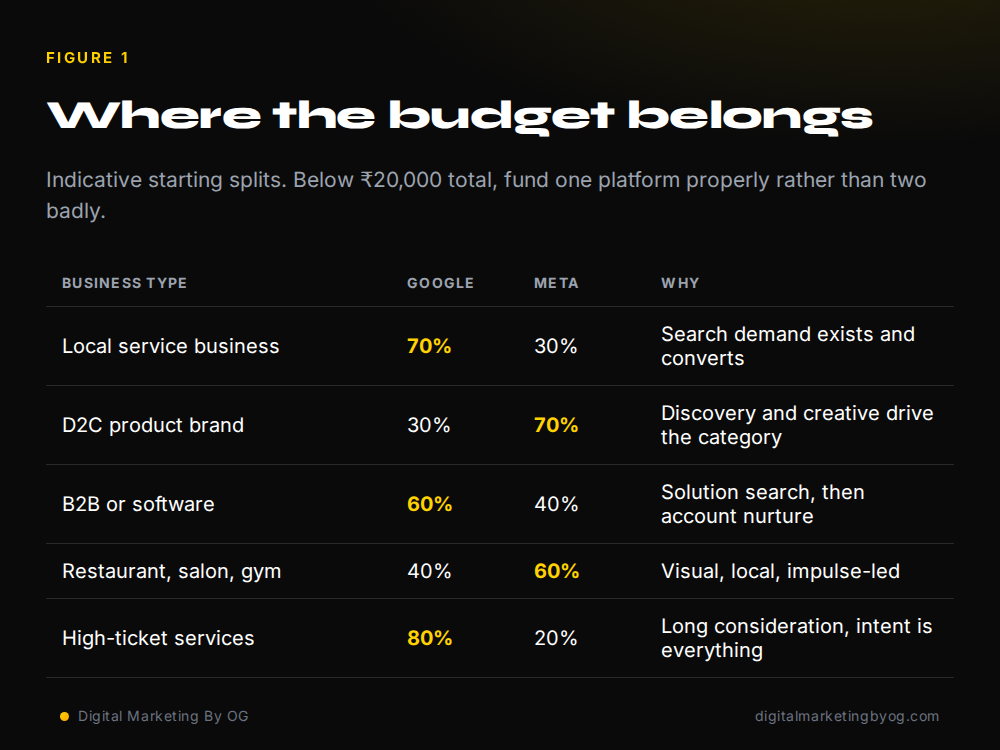
| Business type | Meta | Why | |
|---|---|---|---|
| Local service business | 70% | 30% | Search demand exists and converts; Meta builds recall in the area |
| D2C product brand | 30% | 70% | Discovery and creative drive the category; Shopping campaigns catch the rest |
| B2B or software | 60% | 40% | Search for solutions, LinkedIn and Meta for account nurture |
| Restaurant, salon, gym | 40% | 60% | Visual, local, impulse-led |
| High-ticket professional services | 80% | 20% | Long consideration, low volume, intent is everything |
Below roughly ₹20,000 a month in total spend, split the budget at your peril. One platform funded properly beats two starved, because both algorithms need a minimum volume of conversions before they optimise at all.
What actually moves performance on each platform
On Google, the lever is relevance. Tight ad groups, search-term reports read weekly, negative keywords added continuously, and a landing page that repeats the searched phrase back to the visitor. Most wasted Google spend in Indian accounts goes to broad-match terms nobody ever reviewed.
On Meta, the lever is creative. Targeting matters far less than it did; the algorithm finds buyers if the creative earns attention. Plan on three to five new creatives a week, expect most to fail, and judge them on cost per result rather than on likes. When a D2C account I ran reached a ten-times return on ad spend, the change that got it there was creative volume and Shopping feed hygiene — not a clever audience.
Measurement, honestly
Neither platform reports neutrally. Meta claims conversions it influenced but did not close; Google over-credits branded search that would have happened anyway. Three habits fix most of it: install server-side or conversion API tracking rather than relying on the browser pixel alone, ask every lead where they heard of you and record the answer, and compare total enquiries against total spend month over month rather than trusting either dashboard in isolation.
The mistakes that waste the most money
- Sending paid traffic to the homepage instead of a page about the thing that was searched for
- Judging campaigns after four days and switching them off before the learning phase ends
- Running Performance Max with no negative keyword list and no brand exclusion
- Using one creative on Meta for two months and blaming the platform for rising costs
- Optimising for clicks or reach when the business needs enquiries
- No retargeting, which means paying full price to reach the same person twice
Frequently asked questions
Which is cheaper in India, Google Ads or Meta Ads?
Meta is almost always cheaper per click and per thousand impressions. Google is usually cheaper per qualified lead for services, because the traffic is already looking for what you sell. Compare cost per enquiry, not cost per click, or you will reach the wrong conclusion.
What is a realistic minimum monthly ad budget?
For a local service business, around ₹15,000 to ₹20,000 a month of media spend on one platform is the point where data becomes meaningful. Below that you can still get leads, but you cannot optimise, because there are not enough conversions for the algorithm or for you to learn from.
Should I run both platforms at once?
Only once one is working and funded. Start where your buyers already are, prove the funnel converts, then add the second platform to widen the top of it.
How long before ads start performing?
Google search campaigns can produce enquiries in the first week. Meta typically needs two to four weeks and a meaningful number of conversions before costs settle. Judging either before the learning period ends is the most expensive habit in paid media.
Do ads help SEO?
Not directly — paid spend is not a ranking factor. Indirectly it helps a great deal: ads reveal which keywords convert before you invest months of SEO in them, and the branded searches they generate strengthen your organic footprint.
About the author
Related guides
- Google Ads management — Search, Display, Shopping and Performance Max, managed for leads.
- Meta Ads management — Facebook and Instagram campaigns with creative included.
- How to choose an SEO expert in India — the organic side of the same budget conversation.
Not sure which platform your money belongs on? Tell us what you sell and to whom on the contact page and you will get a straight recommendation, including when the answer is neither yet.